I gave my first shot today in pharmacology lab. I hadn't worked up my usual pre-first nerves since I didn't know I'd be doing it. The lab began innocuously, as I injected blue saline into a hotdog to practice intradermal injections. But then we had to give the subcutaneous shots to each other, a shot of saline in the back of the arm. I practiced on a creepy dummy arm three times first. (Note: there are tons of dummy body parts in the simulation lab. On opening a cabinet to look for the bottom of the sharps container, there was a random and unassuming foot hanging out. Two weeks ago, we administered medicine through a PEG tube that went into a 6-in by 6-in abdomen fragment that had been taken out of a dummy and placed into the sink. There's even a dummy that gives birth that we'll use when we do maternity lab.)
Anyways, then came the moment, and my partner offered to let me go first. I talked out loud for each step, dictating what I was about to do, hoping that if I were about to make a mistake, the instructor would stop me before my words turned into medical malpractice. I was pretty nervous, even though I knew those things don't usually hurt. Even though I'd watched another girl give an injection, seen it on the instructional videos, and practiced on the dummy arm, there's still this quantum leap between knowing and doing that presents itself as a sink-or-swim moment. If you wait until you feel prepared, you'll never take the leap, so I did it. And then it was over. No catastrophe, no blood, no tears. Success. I was so relieved that I was not the least bit nervous about receiving my partner's injection, her first as well.
That's the thing about firsts. I get entirely too nervous about them. There's all the worrying that comes before the preparation. Then there's the preparation. Then there's the practicing, the attempts to replicate the scenario as much as possible without actually doing it. And then some more agonizing over all the ways it could go wrong. And then at some point, I've got to stop planning, preparing, catastrophizing and just take the plunge. No matter how much I've prepared for it, the first always seems an impulsive moment. A "wait for it, wait for it, wait for it... go!"
And then it's over, its exit having none of the fanfare of its entrance. I'd built it up to be this grand ordeal, a parade of steps that each must go right, and really, it's a simple moment, slipping quietly by with no pomp and circumstance. For all the nail-biting anticipation, you could miss it if you blinked.
And so I'm glad that the moment kind of sneaked up on me today. I still prepared, read over the skills checklists and the techniques we were to use, but because I believed that the hotdog would be the closest I'd get to a live patient, I didn't set up the usual pressure that weighs on uncertain situations. And imagine that-- I lived to tell about it, and so did my lab partner.
Tuesday, October 16, 2012

Tuesday, September 25, 2012
bears
In the past week, I have watched the same episode of "Bear in the Big Blue House" five times. I am sure I will watch it again on Thursday. The 2-year-old boy I babysit sits enthralled on the couch while Bear plays with his friends Ojo, Tree-lo, Shadow, Luna, the Otters, and the mouse Tuttle (my favorite because he's so frenetic and always worked up about something). I find Bear and company far less creepy than the Wiggles, adult men who wear a rainbow spectrum of turtlenecks and dance awkwardly and seem not to realize that they are, in fact, adults.
The central conflict of this episode is that Bear can't find Tree-lo to explain what fall is about. He finally finds him at the end trying to glue the leaves back on the trees to "fix" them (assist goes to the purple otters) and explains that the trees are okay, that the leaves are supposed to fall off to make room for new leaves come spring. Tree-lo, satisfied with this new information, joyously exclaims that the trees are okay and that he loves spring, and Bear retreats to go sing a song with the moon.
I am nostalgic for the days when knowledge was a panacea for troubles of any kind, when any problem could be remedied by information handed down to me by an adult, which I accepted as the gospel truth simply because an adult said it. Note: this didn't even have to be a legal adult, simply someone who seemed old enough to know what they're talking about, for instance, the average twelve-year-old.
Now, I am one of those "adults," and while I thought I would have all the answers by now by virtue of having a college degree, I am left with more questions than ever. So many times, I'm even one step behind that, not even knowing what the question is. There's a sense of unsettled uncertainty, but I can't even formulate it into words. In a world where encyclopedic amounts of knowledge are accessible through a simple google search, there is no solution for those who don't even know what they don't know. You can't google "I'm confused" and expect an explanation or type in "Where should I go" to mapquest and find step-by-step directions from your driveway to your future.
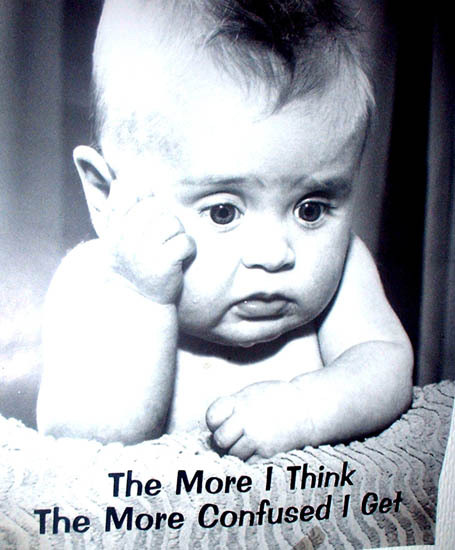
If, however, you were tempted and did google "I'm confused," this is the first image that would pop up.

From one of my favorite books:
"When you’re lost in those woods, it sometimes takes you a while to realize that you are lost. For the longest time, you can convince yourself that you’ve just wandered off the path, that you’ll find your way back to the trailhead any moment now. Then night falls again and again, and you still have no idea where you are, and its time to admit that you have bewildered yourself so far off the path that you dont even know from which direction the sun rises anymore." – Elizabeth Gilbert
The central conflict of this episode is that Bear can't find Tree-lo to explain what fall is about. He finally finds him at the end trying to glue the leaves back on the trees to "fix" them (assist goes to the purple otters) and explains that the trees are okay, that the leaves are supposed to fall off to make room for new leaves come spring. Tree-lo, satisfied with this new information, joyously exclaims that the trees are okay and that he loves spring, and Bear retreats to go sing a song with the moon.
I am nostalgic for the days when knowledge was a panacea for troubles of any kind, when any problem could be remedied by information handed down to me by an adult, which I accepted as the gospel truth simply because an adult said it. Note: this didn't even have to be a legal adult, simply someone who seemed old enough to know what they're talking about, for instance, the average twelve-year-old.
Now, I am one of those "adults," and while I thought I would have all the answers by now by virtue of having a college degree, I am left with more questions than ever. So many times, I'm even one step behind that, not even knowing what the question is. There's a sense of unsettled uncertainty, but I can't even formulate it into words. In a world where encyclopedic amounts of knowledge are accessible through a simple google search, there is no solution for those who don't even know what they don't know. You can't google "I'm confused" and expect an explanation or type in "Where should I go" to mapquest and find step-by-step directions from your driveway to your future.
If, however, you were tempted and did google "I'm confused," this is the first image that would pop up.
From one of my favorite books:
"When you’re lost in those woods, it sometimes takes you a while to realize that you are lost. For the longest time, you can convince yourself that you’ve just wandered off the path, that you’ll find your way back to the trailhead any moment now. Then night falls again and again, and you still have no idea where you are, and its time to admit that you have bewildered yourself so far off the path that you dont even know from which direction the sun rises anymore." – Elizabeth Gilbert
Sunday, September 16, 2012
getting out of the car and moments like these
Well, it's been a while since I updated. Life has been moving pretty quickly. I've been in nursing school for three weeks now. While the studying is a drag, the information is really interesting, and I find myself really able to connect the new things I'm learning with things from past courses and with future applications. Also, reading about all the different ways in which people can become sick makes me marvel at the fact that anybody is healthy. It seems like we should all be walking around infested with bacteria and with kidney and liver failure and one arm falling off, and yet our bodies have this amazing restorative capacity and incredible resilience. It's really given me an appreciation for how blessed I am, but there is always that moment when I'm reading a set of symptoms and begin to worry that my tiredness is really a symptom of "insert dramatic illness here" rather than a result of staying up too late the night before. It definitely can make your head spin if you're not careful.
I've been babysitting for three boys, who are 10, 7, and 2, a couple days a week, and they're completely adorable and yet exhausting. The two-year-old is who I watch the most, since the other boys spend a lot of time at school or in activities, and he's the cutest thing ever but incredibly curious and active and always asking "why." Whenever something isn't right to him, he looks at me and says, "It's broken," whether it's that his sandwich has fallen apart or he's just noticed my nose ring for the first time.
And I've been building up my mileage to prepare for the Marine Corps Marathon, which is in late October in D.C. Today was the Philly half marathon, so my dad and I trekked up there at 5:30. It was mentally challenging, and I had a lot of difficulty breathing, which wasn't helped much by my inhaler, but I set a PR by a minute, so I was really happy with it. I'm sure that tomorrow I will be cursing every muscle in my legs, but for now I'm pleased.
All this has left me little time for reflection, and I'm much happier for it. It's an odd sensation, though. For most of my life, I've felt as though the days have dragged by. But for the past six months or a year, time has just flown. I've felt each day when I get out of my car in the parking garage that it was really just moments ago that I was shutting the car door the morning before. It seems like the twenty-four hours that have gone by in between could collapse into a single breath and just vanish. And so looking back on a week just seems like a montage of this me-getting-out-of-the-car scene, with nothing changing except my clothes.
This makes me think of the scene in The Bell Jar when Esther describes how each day is a white box with a black curtain separating it from the next day until suddenly someone has drawn up all the curtains and all that's left is a blinding white stream. Except for her, it's an incredibly depressing and overwhelming sensation, and for me, it's disorienting and dizzying but not really a negative thing at all.
So, that's it. Life is good.
I've been babysitting for three boys, who are 10, 7, and 2, a couple days a week, and they're completely adorable and yet exhausting. The two-year-old is who I watch the most, since the other boys spend a lot of time at school or in activities, and he's the cutest thing ever but incredibly curious and active and always asking "why." Whenever something isn't right to him, he looks at me and says, "It's broken," whether it's that his sandwich has fallen apart or he's just noticed my nose ring for the first time.
And I've been building up my mileage to prepare for the Marine Corps Marathon, which is in late October in D.C. Today was the Philly half marathon, so my dad and I trekked up there at 5:30. It was mentally challenging, and I had a lot of difficulty breathing, which wasn't helped much by my inhaler, but I set a PR by a minute, so I was really happy with it. I'm sure that tomorrow I will be cursing every muscle in my legs, but for now I'm pleased.
All this has left me little time for reflection, and I'm much happier for it. It's an odd sensation, though. For most of my life, I've felt as though the days have dragged by. But for the past six months or a year, time has just flown. I've felt each day when I get out of my car in the parking garage that it was really just moments ago that I was shutting the car door the morning before. It seems like the twenty-four hours that have gone by in between could collapse into a single breath and just vanish. And so looking back on a week just seems like a montage of this me-getting-out-of-the-car scene, with nothing changing except my clothes.
This makes me think of the scene in The Bell Jar when Esther describes how each day is a white box with a black curtain separating it from the next day until suddenly someone has drawn up all the curtains and all that's left is a blinding white stream. Except for her, it's an incredibly depressing and overwhelming sensation, and for me, it's disorienting and dizzying but not really a negative thing at all.
So, that's it. Life is good.
Monday, August 13, 2012
Hope
Last week, my sister and I saw the new Batman movie. There was a punishment where people were dropped into a deep pit, a literal hell on earth. It was inescapable, but the sky was visible from the depths of the pit. This was to enhance the suffering, one of the characters said, because without hope there could be no true despair.
I wonder about thus. I usually think of hope as a protective factor against despair, giving me a reason to fight on. However, continually hoping and continually being disappointed in those hopes is perhaps a much deeper form of suffering than having no hope at all.
Consider a man who cannot beat his weightbon his legs if he holds onto hope, he will repeatedly stand and fall, accruing bruises and despair as his legs crumble time and time again. The man with no hope will stay down and thus, he only has to fall once. After that, he is safe because there is nowhere left to fall. Resting a cheek against rock bottom can be comforting because it absolves us of the responsibility to keep fighting in the face of the fear of failure. When we stop hoping, we allow ourselves to give up.
While sometimes giving up on the impossible is adaptive, we often mistake for impossible what is merely improbable. Thus subtle distinction lies at the heart of the decision to hope. If we give up on the improbable, we save ourselves the trouble of pain and disappointment and dashed expectations. However, we also rob ourselves of truly living.
Safety is important, but in large doses, it can be stifling, suffocating, smothering. In falling and rising, we gain toughness and strength so that one day we can rise for good. When we stop hoping we are essentially saying that comfort is more important than fulfillment and that we value the avoidance of pain more than the pursuit of life.
I'll close with a favorite quote from Vaclev Havel: "Hope is a state of mind, not of the world. Hope, in this deep and powerful sense, is not the same ad joy that things are going well or willingness to invest on enterprises that are obviously headed for success but rather an ability to work for something because it is good."

Monday, August 6, 2012
change

I've been thinking a lot about change lately. It's an interesting thing, ever present and unavoidable.
Sometimes, change is sudden. An iron curtain falls down and splits reality into "then" and "now." Sometimes it sneaks up so slowly that we don't even notice it creeping closer and closer. Sometimes change is voluntary and effortful, and sometimes it is violent and forced and unwelcome. Sometimes change is progressive and we march triumphantly forwards, and sometimes it is regressive and doesn't look like change at all because it is a return to a familiar past.
About all that I know about change is that it is constant and unstoppable-- the force that breathes life into our years. We may beg for it or we may fear it, but we cannot avoid it. It usually looks different than we expected, and sometimes it is more brilliant even than our highest hopes.
Change is not an intention-- it is movement. It does not live in our heads but in our action or inaction. Seek to hide from it, and its ugly sister--stagnation--will find you. This, too, is a kind of change, a change into something smaller and sadder and weaker. We must be mindful of our tendency to change and hook our efforts onto directing this change towards growth, towards progress, towards our dreams and goals.
We will never be done, but we are rewarded for each step we take. The distant dream is not a mirage-- it is as real as you or me. It may seem to get further and further away, but that is only because as we approach it, we gain a truer understanding of what we are seeking. Where we were once aiming only to be good, we now understand that we must strive to be better. Not better than those around us but better than our nagging sense of doubt convinces us we can be.
So I will keep walking this road of eternal change all the days of my life, hoping to be transformed into something beautiful and honest and real.
Tuesday, July 31, 2012
dreams, knowing, and the pussycat dolls
What do I want to be when I grow up? Well, the Pussycat Dolls, oft-misquoted, say they want to "have groupies," but I appreciate being able to go to the grocery store with no makeup on.
My earliest answer on record is tucked away in some box under the bed. When I was four, my best friend and I said in our school "getting-to-know-you" guide that we wanted to be princesses. My step-cousin pointed out, as I climbed out of the pool during my prolonged awkward phase, dried my frizzy hair, and put my dorky glasses back on, that I looked like Anne Hathaway in The Princess Diaries "before the makeover." Ouch.
Since then, I've been asked the question many times and had a ton of different responses and a lot of aimless shrugs.
There were the days when I wanted to be a ballerina. It seemed awfully glamorous. One of my ballet teachers, who must have been about eighteen at the time, drove a bright yellow Volkswagen Beetle with press-on smiley face stickers (it was the 90s), and I thought she was the coolest person alive. Fear of bright lights notwithstanding, the thought of being so graceful I got paid for it was appealing. Also, I was in love with stage makeup because it was like grown-up-sanctioned dress up.
Then there were the days of wanting to be a writer. I would come up with story ideas and begin them furtively before losing interest. They would begin with my mind wandering, asking "what if" and then exploring where territory went. They were long, and I mean long, on detail, and I remember being shocked when my English teacher explained what it meant to be concise. How could writing less be a good thing? I thought I might write poetry, then, and I thought rhyming dictionaries were cheating because it seemed that half the fun was coming up with absurd rhymes.
Then there were the days of wanting to be a marine biologist. What this really meant was that I wanted to play with the dolphins at Sea World. I wanted Shamu to be my best friend, and I was not the least bit interested in hearing that there were hundreds of Shamus. To me, there was but one, and I would train him someday.
Then I kind of spun off course. For many years, I stopped dreaming a bit and didn't know what I wanted. Writing still sounded appealing, but having dreams that impractical seemed foolish and childish. Teaching was out of the question because I had a horrible fear of being wrong and had a recurrent sense that I might teach the class some long-winded explanation and then have to un-teach them the next day because I had been all wrong. I started running, and suddenly, the idea of being a ballerina seemed far-fetched and ridiculous, as I could barely touch my toes anymore. I realized that marine biologists had to be interested in things like plankton, and that sounded awful. I thought about being a doctor, but what pressure-- suppose someone died on my watch.
This not-knowing lasted for quite some time. I wanted THE answer and didn't have it.
So as I prepared to go off to college, I told people I wanted to major in international relations or biomedical engineering, without really having an understanding of what either was about. I applied to schools within the universities I applied to based on what I thought were the strengths of that school. Since I got a scholarship to Vanderbilt and I had applied to their engineering school, I began college majoring in biomedical engineering.
I hated it, but whenever someone brought up the possibility of switching majors, even during freshman year, I would insist that I had already invested too much time in it and didn't want to become behind. BEHIND. I don't know whom it was that was always one step ahead of me, but that invisible force drew me forwards and kept me heading down a course I hated.
My sophomore year was tumultuous to say the least, but I eventually gave up engineering. I chose a new major--medicine, health, and society. I LOVED it. I thought I'd work in health policy, and I was on fire. My parents suggested that the best way to do this might be to go to law school, and so that's what I set out to do. I was in love with having a plan. I had a detailed map of what to do with my life and how to do it, and it set my mind to rest. I thought the journey was over.
And yet, I would grow unsettled. I wondered how much law school really had to do with health policy after all. My boyfriend at the time, himself a third year law student, assured me the two disciplines were very unrelated. At the same time, I was volunteering at a hospice for one class and visiting health care clinics for vulnerable populations that were run by local nurse practitioners in another. Slowly, the idea came to me that I should be a nurse practitioner.
This idea unsettled me. I didn't want to change paths yet again. I thought stubbornly that I had already made up my mind and wondered why these doubts came up now. It seemed "too late" to change course. I fancied myself a middle-aged career woman, not a college student. I resisted the desire to be a nurse with every fiber of my being. And then one day, I stopped resisting. In the final week of my junior year of college, I suddenly knew that I wanted to be a nurse practitioner. And this was not like the old knowing but an entirely new kind of assurance that I had complete faith in.
I still took the LSATs a month later, still kept law school open as a possibility just in case I changed my mind, but I knew I wouldn't. From day one, I began scripting a plan for the classes I would need to take to prepare to enter an accelerated nursing program when I finished senior year. I've made many revisions along the way, but I am finally almost there.
Yesterday, I picked up my student ID and bought some scrubs and my medical supplies. I insisted that my parents sit down so I could use my new "anaerobic sphygmomanometer" to take their blood pressure, and as I listened to the blood coursing through their brachial arteries, I knew that this is it.
And so I'm excited. And I've realized that attaching my wagon to one dream does not mean I abandon the rest. I still write from time to time. I swam with the dolphins at Sea World on a family vacation. I danced, awkward and un-self-aware, at my fair share of homecomings and proms. I watch crime dramas on TV and argue about health reform. I'll never be a princess, but I got a tiara from a sketchy costume shop in the bad part of town for my birthday party one year.
Yes, the best way to know life is to live it.
My earliest answer on record is tucked away in some box under the bed. When I was four, my best friend and I said in our school "getting-to-know-you" guide that we wanted to be princesses. My step-cousin pointed out, as I climbed out of the pool during my prolonged awkward phase, dried my frizzy hair, and put my dorky glasses back on, that I looked like Anne Hathaway in The Princess Diaries "before the makeover." Ouch.
Since then, I've been asked the question many times and had a ton of different responses and a lot of aimless shrugs.
There were the days when I wanted to be a ballerina. It seemed awfully glamorous. One of my ballet teachers, who must have been about eighteen at the time, drove a bright yellow Volkswagen Beetle with press-on smiley face stickers (it was the 90s), and I thought she was the coolest person alive. Fear of bright lights notwithstanding, the thought of being so graceful I got paid for it was appealing. Also, I was in love with stage makeup because it was like grown-up-sanctioned dress up.
Then there were the days of wanting to be a writer. I would come up with story ideas and begin them furtively before losing interest. They would begin with my mind wandering, asking "what if" and then exploring where territory went. They were long, and I mean long, on detail, and I remember being shocked when my English teacher explained what it meant to be concise. How could writing less be a good thing? I thought I might write poetry, then, and I thought rhyming dictionaries were cheating because it seemed that half the fun was coming up with absurd rhymes.
Then there were the days of wanting to be a marine biologist. What this really meant was that I wanted to play with the dolphins at Sea World. I wanted Shamu to be my best friend, and I was not the least bit interested in hearing that there were hundreds of Shamus. To me, there was but one, and I would train him someday.
Then I kind of spun off course. For many years, I stopped dreaming a bit and didn't know what I wanted. Writing still sounded appealing, but having dreams that impractical seemed foolish and childish. Teaching was out of the question because I had a horrible fear of being wrong and had a recurrent sense that I might teach the class some long-winded explanation and then have to un-teach them the next day because I had been all wrong. I started running, and suddenly, the idea of being a ballerina seemed far-fetched and ridiculous, as I could barely touch my toes anymore. I realized that marine biologists had to be interested in things like plankton, and that sounded awful. I thought about being a doctor, but what pressure-- suppose someone died on my watch.
This not-knowing lasted for quite some time. I wanted THE answer and didn't have it.
So as I prepared to go off to college, I told people I wanted to major in international relations or biomedical engineering, without really having an understanding of what either was about. I applied to schools within the universities I applied to based on what I thought were the strengths of that school. Since I got a scholarship to Vanderbilt and I had applied to their engineering school, I began college majoring in biomedical engineering.
I hated it, but whenever someone brought up the possibility of switching majors, even during freshman year, I would insist that I had already invested too much time in it and didn't want to become behind. BEHIND. I don't know whom it was that was always one step ahead of me, but that invisible force drew me forwards and kept me heading down a course I hated.
My sophomore year was tumultuous to say the least, but I eventually gave up engineering. I chose a new major--medicine, health, and society. I LOVED it. I thought I'd work in health policy, and I was on fire. My parents suggested that the best way to do this might be to go to law school, and so that's what I set out to do. I was in love with having a plan. I had a detailed map of what to do with my life and how to do it, and it set my mind to rest. I thought the journey was over.
And yet, I would grow unsettled. I wondered how much law school really had to do with health policy after all. My boyfriend at the time, himself a third year law student, assured me the two disciplines were very unrelated. At the same time, I was volunteering at a hospice for one class and visiting health care clinics for vulnerable populations that were run by local nurse practitioners in another. Slowly, the idea came to me that I should be a nurse practitioner.
This idea unsettled me. I didn't want to change paths yet again. I thought stubbornly that I had already made up my mind and wondered why these doubts came up now. It seemed "too late" to change course. I fancied myself a middle-aged career woman, not a college student. I resisted the desire to be a nurse with every fiber of my being. And then one day, I stopped resisting. In the final week of my junior year of college, I suddenly knew that I wanted to be a nurse practitioner. And this was not like the old knowing but an entirely new kind of assurance that I had complete faith in.
I still took the LSATs a month later, still kept law school open as a possibility just in case I changed my mind, but I knew I wouldn't. From day one, I began scripting a plan for the classes I would need to take to prepare to enter an accelerated nursing program when I finished senior year. I've made many revisions along the way, but I am finally almost there.
Yesterday, I picked up my student ID and bought some scrubs and my medical supplies. I insisted that my parents sit down so I could use my new "anaerobic sphygmomanometer" to take their blood pressure, and as I listened to the blood coursing through their brachial arteries, I knew that this is it.
And so I'm excited. And I've realized that attaching my wagon to one dream does not mean I abandon the rest. I still write from time to time. I swam with the dolphins at Sea World on a family vacation. I danced, awkward and un-self-aware, at my fair share of homecomings and proms. I watch crime dramas on TV and argue about health reform. I'll never be a princess, but I got a tiara from a sketchy costume shop in the bad part of town for my birthday party one year.
Yes, the best way to know life is to live it.
Monday, July 30, 2012
gratitude

They say to write what you know.
I know:
Life is a gift. It is a beautiful, maddening, amazing, and sometimes exquisitely painful gift.
I have sometimes wanted to stand in the return line at Macy's with a gift receipt and exchange it for something shinier, but I know better. I am grateful.
I was always taught to write thank-you notes for gifts, and I still spend the last week of December writing thank-you notes to relatives. Over the years, my gratitude has changed.
It started as pictures scrawled in crayon, which my uncle called "refrigerator art." For years it was a formulaic "Dear ____, Thank you for the _____. It is so pretty. Love, Katie." These days, it's a more heartfelt note, with an update on the family and some well wishes thrown in. Either way, I think if there's one lesson I've learned over and over by messing it up, it's that gratitude, more than kindness or love or tolerance or anything else, is what makes the world go 'round. They are important, for sure, but gratitude acknowledges that we are constantly and abundantly blessed.
Gratitude to God says, "I am small. I am undeserving of Your great love and mercy and grace, and I know that were I to spend the rest of my life trying to prove my worth, I could not. And yet I will accept this great gift and treasure it and build the fiber of my heart around it, so that it is such a part of me that it cannot be torn out. I cannot repay the gift in kind, so I will sow it with deep roots and try to build a life around it."
Gratitude to another person says, "You have offered me something valuable, not just in what is tangible but in the intention behind it. I value you, and I value our relationship. It is give-and-take, not based on strict and calculating equality but based on balance. We put in what we can sacrifice and take what we need."
And so I am thankful for my family and my friends and God and my life. I am thankful for forgiveness and love and acceptance. I am thankful for little pleasures, bad crime dramas on television and long, lazy nights with a friend. I am thankful for things that hurt because there is a blessing in everything. What appears to be meaningless suffering is simply suffering that we cannot yet understand.
I once had to keep a gratitude journal and then reflect on the experience for a seminar I took on emotion my junior year of college. It spanned a week, and it was a hard week. I spent several days of it in the hospital, and yet I chronicled the little things, a phone call from home and juicy strawberries from the cafeteria. It wasn't a life-changing experience, and it didn't catapult me into a new reality. Change doesn't often happen like that. But it did force me to notice my blessings, to open my eyes instead of clenching them shut and wringing my hands in distress.
I used to believe that optimism was just self-delusion, that people who looked on the bright side weren't "in-the-know." That if they just really knew what it felt like to suffer, then they would be pessimists, too. And counting my blessings is still an act of self-will. I have to listen to the Negative Nancy that lives inside my brain and then forcefully turn away, refuse to engage in such wallowing, direct my energy towards what is worth my time.
So I am grateful.

Subscribe to:
Posts (Atom)